Winder: Geometry before Scale
The right geometry
Many real-world systems have a well defined structure. They repeat, rotate, oscillate or move through known states. Yet neural networks are often asked to learn directly from raw data, with no explicit knowledge of that structure; the model has to learn it from scratch.
An electrocardiogram, or ECG, is a good example. It records the electrical activity of the heart. Clinically what matters is where an event occurred within the heartbeat: how long different stages lasted, and whether their normal order or timing changed. This allows clinicians to diagnose heart attacks, arrhythmias, electrolyte abnormalities and a range of other conditions.
A neural network sees samples arranged on a line. A beat lasting 0.6 seconds and one lasting 0.9 seconds therefore occupy different stretches of that line, even when the same underlying sequence of cardiac events is taking place. With enough examples, a model can learn to account for this variation, but this requires more data and more compute.
In an ECG, a more useful coordinate is available. Each heartbeat has a clear starting point: a sharp spike in the waveform called an R peak. Once you know where each beat starts, you can describe any moment in the ECG not by its exact time, but by how far it sits along that particular heartbeat: like a position on a clock face that resets with every beat. That makes the natural shape of the data circular, not a straight line.
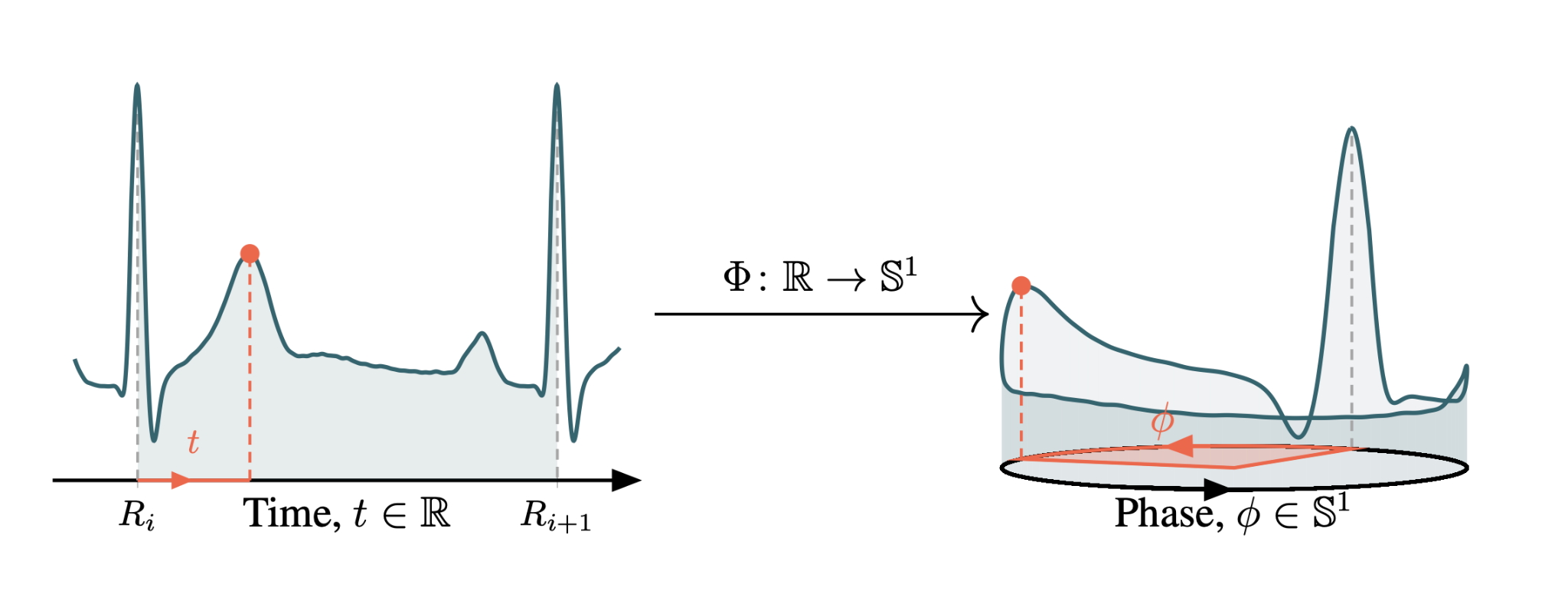
Mapping each heartbeat onto the same circle puts fast and slow beats into a common coordinate system: heartbeat duration can vary while the order of the underlying electrical events is preserved. At inference, phase is estimated directly from R peaks detected in the ECG itself — a simple, fixed calculation rather than something the model has to learn. That means no extra parameters and no extra training just to track where a beat is, keeping the model smaller and faster.
Winder is a self-supervised model built on that coordinate. The heart provides the test case, but the question is broader: what happens when a model is organised around the structure of the system it represents rather than the arbitrary coordinates in which that system happened to be observed?
Closing the cycle
Winder requires the model's internal representation to move predictably as the ECG moves through the cardiac cycle. If the signal advances through a particular part of the heartbeat, the representation should advance through a corresponding phase.
This is a form of equivariance: a known change in the input produces a corresponding change inside the model. Rather than asking the network to discover that relationship independently from examples, we build a known property of the biology into the representation from the start.
Borrowing from quantum mechanics, Winder treats each heartbeat as a closed cycle: after one complete beat, the representation should return to where it started. That simple constraint means patterns can only wrap around the cycle a whole number of times (once, twice, three times and so on) because any other amount would leave them somewhere different at the end of the beat than at the start. Mathematically, this is called a winding number: hence Winder. It gives the model a natural structure for representing recurring cardiac motion, while distortions or breaks in that structure can become useful signals of abnormal behaviour.
Cardiac biology also sets the level of detail the model needs to capture. Some parts of an ECG, such as the sharp QRS complex, happen very quickly, while others, such as the T wave, unfold more slowly across the heartbeat. Winder represents these different timescales with patterns that operate at different speeds, preserving both broad changes and short, sharp events. That gives the model a head start on the timing of a heartbeat, so it can spend its learning capacity on what actually varies between patients and with disease, rather than relearning the basic rhythm each time.
Inside the representation
We also looked inside the representation to see whether Winder had learned the cardiac structure we intended.
Across a heartbeat, its latent space develops a clear cyclic structure, and position within that structure corresponds to the actual phase of the cardiac cycle.
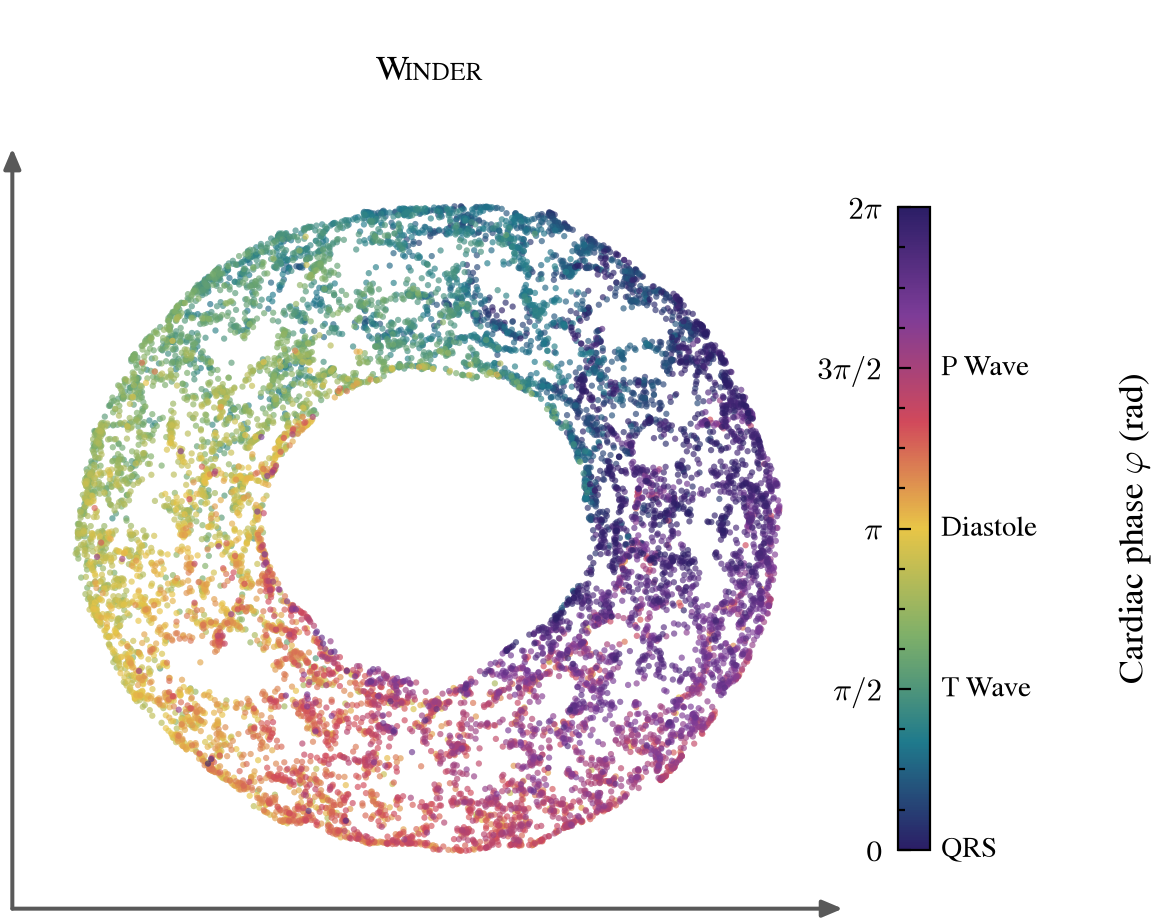
Each point is a moment from an ECG, positioned by Winder's internal representation and coloured afterwards by its true cardiac phase. The points form a continuous ring, with colours progressing smoothly around it in the same order these events occur in a real heartbeat — we recover representations fully encapsulating the progression of cardiac physiology, cycle by cycle.
The structure also makes the model more robust when the input is imperfect. Removing a single ECG lead has a smaller effect on Winder's performance than it has on comparable models.
Smaller models, wider reach
The common answer to a hard modelling problem is more data, more parameters and more compute. Winder provides another lever: the right insight into a problem can let a model do more with less, and geometry is one powerful way to put that insight to work. Better geometry can make a model simultaneously more accurate, more robust and smaller.
Smaller models need less memory and compute. They can run on monitors, wearables and edge devices, closer to where the data is generated. That makes deployment cheaper and easier across large numbers of people.
Broader deployment can in turn produce larger and more diverse datasets, improving the models that follow. Geometry does not replace scale. At every level, it makes scale more effective.
Beyond the heart
Not every system has a clean cycle, and not every useful state is directly observable. In sleep, for example, estimating the relevant state may itself be part of the problem.
The opportunity is broader than cycles of the heart. Biological and physical systems are not arbitrary datasets — they carry structure of their own. Some changes don't alter what a system means, like rotating a photo of a face. Some affect it in ways that are already known, the same idea behind Winder's own phase constraint. Some systems have natural coordinates, like a heartbeat. Others are limited in how they can change at all.
None of this depends on data. These are facts about the system before the first training example is collected.
Modern machine learning has made enormous progress by scaling data, parameters and computation. That remains powerful. But scale is not the only source of information available to a model. When something fundamental about a system is already known, that knowledge can shape the learning problem from the start.
This is at the core of what we do at TimeTrace Labs. Winder applies it to the geometry of cyclic systems. Other physical and biological systems have different structures, but the principle is the same: use what is already known about the world to reduce what has to be learned from data.
Efficiency by way of mathematical insight.
Acknowledgements
This work was supported by Innovate UK, part of UK Research and Innovation (UKRI), under grant number 10201397, and trained on Isambard AI.
The full Winder paper is available on arXiv: https://arxiv.org/abs/2608.21147
Please cite this work as:
TimeTrace Labs and NVIDIA. Winder: Geometry before Scale. TimeTrace Labs Blog, August 2026.
BibTeX:
@article{timetrace2026winder,
author = {{TimeTrace Labs} and {NVIDIA}},
title = {Winder: Geometry before Scale},
journal = {TimeTrace Labs Blog},
year = {2026},
url = {https://www.timetracelabs.com/blog/winder}
}